Does a large industrial oven include a trolley as standard?
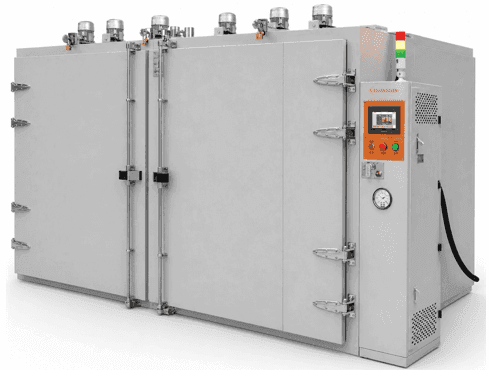
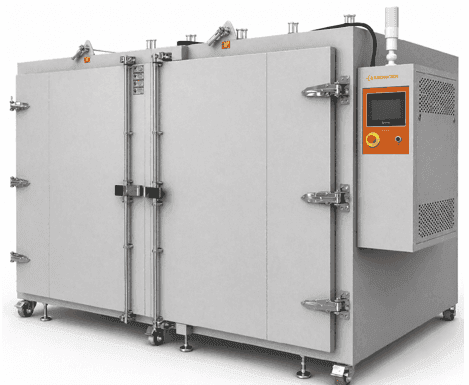
Trolleys, carts and transfer/loading trolley systems must be selected as part of the configuration. Specify workpiece weight, the loading route and positioning requirements, then confirm compatibility between the trolley, fixtures, door opening and chamber space.
Can a small-oven recipe be used directly for a large batch?
Scaling up the load changes workpiece thermal mass, airflow obstruction and heating and cooling times. Revalidate workpiece temperatures at representative locations and the material endpoint, with particular attention to the basis for starting the hold timer.
Can LIO be purchased as a large vacuum oven?
Evaluate LIO against its published hot-air-circulation industrial oven configuration. Chamber size does not establish vacuum capability. If large-scale reduced-pressure drying is required, specify the vacuum structure, pump system and sealing requirements separately.
How should loading be selected for trolley ovens and rail-mounted ovens?
Trolley ovens focus on moving a complete loaded trolley in and out. Purchasing requirements for a rail-mounted oven must also specify rail gauge, wheels, load capacity and positioning. LIO offers optional trolleys, carts and transfer/loading trolley systems; rail structures must be confirmed for the specific design. Also check clear door dimensions, site aisles, full-load airflow paths and workpiece securing.
How should hot-air circulation ovens and high-temperature forced-convection drying ovens be compared?
These terms often describe equipment using gas flow for heat transfer, but maximum operating temperature, usable working zone, circulation paths and full-load temperature distribution still require confirmation. LIO uses hot-air circulation heating and can be evaluated for large workpieces and batch heat treatment. For drying, also specify material outgassing and exhaust conditions.
Can a large oven serve as a drying room or walk-in unit?
Large volume does not establish the structure and interlocks needed for personnel entry. Select LIO by workpiece and trolley loading requirements. If the requirement involves a drying room, walk-in loading or special doors, confirm the structure, load-bearing capacity and operating arrangement separately; chamber volume alone does not establish suitability.
What information is needed for a large industrial oven quotation and site installation?
In addition to operating temperature, workpiece dimensions, mass and batch size, provide transport access, installation space, door orientation and power supply conditions. State whether trolleys and fixtures are included in the supply, and calculate throughput and operating costs from the complete full-load heating, holding, cooling and loading/unloading time.